


COLLECTABLE STORIES: SILENT STABLE

SILENT STABLE
Short Talk with Nathan Coen (director)

BEST SHORT FICTION FILM Category
22nd IN THE PALACE International Short Film Festival 2025
France, Fiction, French, 00:19:53, 2025
Synopsis: Felix, a 9-year-old boy, is about to move. He spends his free time at a stable but has never dared to ride a horse. He admires Victoria, a twelve-year-old equestrian prodigy. However, Felix is troubled by intriguing events: he observes with concern his friend's gradual distance and notices a strange relationship between her and their coach.
Biography: Nathan Coen began his career studying architectural and art photography before pursuing audiovisual studies at ESRA Paris. He worked as an assistant cameraman before joining the Ateliers du Cinéma de Beaune, where he trained under Claude Lelouch for three years. During this time, he wrote Silent Stable. Now a director, he also works in color grading at HD- Systems, deepening his passion for image-making.
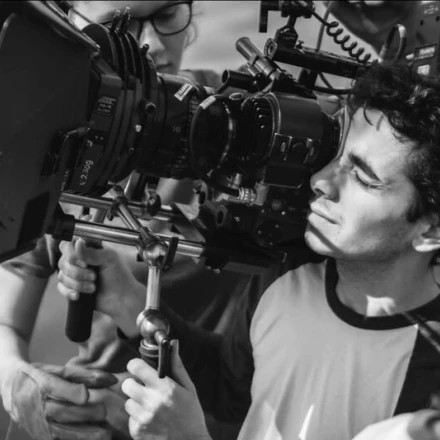 Nathan Coen, director
Petar Penev: You had several horses, and they all seemed very well-behaved. What was your experience working with animals on set?
Nathan Coen: I actually didn’t have any prior experience with horses. But we shot at my uncle’s stud farm, and he was there to handle them with us. We also had a long pre-production period, we did a lot of test shoots beforehand. I even wrote a short film with horses just to test how they reacted to big cameras, cranes, and lights, and to help find funding and build the team for Silent Stable.
Petar Penev: Were any of the actors already experienced riders, or did they learn during the shoot?
Nathan Coen: No, that was one of our casting questions. In France, riding is a popular sport, so it wasn’t hard to find a young actress with a high skill level.

Petar Penev: At some point in the film, you also work with several underage actors. Was it difficult managing so many children on set? Kids can get tired more easily and often need a different approach.
Nathan Coen: I thought it would be difficult, but both of the young actors were very mature. They already had some experience in cinema, so they were very professional. In fact, they even helped me, suggesting dialogue changes or offering new ideas.
Petar Penev: That’s interesting. Can you give a specific example?
Nathan Coen: When you’re writing for children, it’s hard to make their lines sound natural, they have their own vocabulary. Owen, the young boy in the film, told me he didn’t feel comfortable with a certain line and asked if he could say it differently. Sometimes I accepted, sometimes we negotiated a change. We even rewrote small bits of dialogue during shooting.

Petar Penev: Speaking of dialogue, you wrote the screenplay yourself. In this film, what’s not said feels as important, if not more so, than what is spoken. Was that intentional from the beginning?
Nathan Coen: Yes, right from the start. I wanted a character who carries something inside that others can’t quite see. And I like shooting that way, where sound and image are as important as dialogue. The story is told through words, yes, but also through looks, gestures, and sound.
Petar Penev: It sounds like almost nothing changed from the initial idea to the final film, apart from a few lines. Was that the case?
Nathan Coen: Not exactly. One major change came in editing. Originally, the scene showing the relationship between the coach and the athletes was at the end. But a director I admire told me I needed to put it at the beginning. That way, viewers could better understand the glances and unspoken relationships between characters. Without it, for someone unfamiliar with equestrian sports, those dynamics were too subtle to follow.
Interviewer: Petar Penev
Editor: Martin Kudlac
Petar Penev’s Take
Silent Stable by Nathan Coen is a short coming of age drama that examines childhood perception and the subtle dynamics of power within youth sports. Set in a French equestrian stable, the story unfolds through the perspective of Félix (Owen Tannou), a nine-year-old boy about to move away, who spends his days at the stables admiring an older equestrian prodigy while growing increasingly unsettled by her distance and by the ambiguous relationship he observes between her and their coach.
The film’s strength lies in its ability to convey a sense of unease and foreboding without overt dramatization. It is a rare contemporary example of a work that communicates more through silence than dialogue. Coen’s controlled approach goes further utilizing naturalistic light and a muted palette to evoke a sense of intimacy and realism. Close framing and lingering shots keep the audience aligned with Félix’s point of view, attuned to his silent observations and internal turmoil.
Silent Stable explores the fragile balance between admiration and manipulation. Through Félix’s interactions with Victoria (Blanche Bauduin), a young equestrian prodigy, and their coach, the film subtly probes the ambiguities of mentorship and the conditions under which authority can slip toward exploitation. The screenplay favours suggestion over declaration, allowing tension to accumulate through small, seemingly benign moments that gradually reveal a more troubling undercurrent. The performances are deliberately understated yet effective. The young actors convey emotional complexity through restraint, a choice that aligns closely with the film’s overall tone and deepens its impact.
Silent Stable is a carefully constructed short film that approaches difficult subject matter with sensitivity and insight. Coen’s direction and the film’s artistic execution provide a reflective examination of aspects of childhood experience that are often overlooked.


