


COLLECTABLE STORIES: BIRTH CONTROLLED

BIRTH CONTROLLED
Short Talk with Isa Fraga-Abaza (director)

BEST SHORT STUDENT ANIMATION FILM Category
22nd IN THE PALACE International Short Film Festival 2025
United States, Animation, English, 00:04:59, 2024
Synopsis: This film is a visceral response to a lifetime of medical neglect, patriarchal control, and the systemic failure to treat vaginas as vital organs essential to health and well-being. It reflects the deep frustration and loss of autonomy I have experienced over my own body. We live in a world that fetishizes controlling vaginas while denying them the care they deserve.
Biography: Isabela Fraga-Abaza is a Latina-Arab animator and artist from Washington, DC, with a BFA in 2D Animation from Pratt Institute. She specializes in 2D animation, clay painting, experimental storytelling, and performance. Her work offers a unique perspective through the female gaze, serving as a mirror that encourages viewers to confront their own biases and discomforts.
 Isabela Fraga-Abaza, director
Evgenia Timova: Isa, your film mashes up clay, 2D, politics, religion, and a lot of tropes. It’s chaotic, raw, and very feminist. What was the hardest image to get right, not just technically, but emotionally? Was there a moment where you thought, “Maybe I’m going too far”?
Isabela Fraga-Abaza: I think the hardest thing to get across was that it was consensual for the main character. She was choosing to be there, even though she was putting herself through all this pain and trauma. By the end, you see she’s doing it for her parents. That’s how she’s making money and sending it back home. Showing that it was her choice really adds to the story.
Evgenia Timova: And as a recent graduate, what role did your academic community, teachers and peers, play in shaping the film?
Isabela: Just being able to work with my peers every day, we were all dying in the studio trying to finish our films together. They really supported me. I was also going through a lot of gynecological trauma and health issues at that time, so having a solid support system was really helpful. And just having people watch the film develop, it almost became their film too. It felt good to have their insight.
Evgenia Timova: Yeah, collaboration and support really seem key, especially in animation, which, can be quite a traumatic process. This is your directorial debut, and a strong one. If someone watches Birth Controled ten years from now, what trace of your voice do you hope they’d recognize?
Isabela: I’d say probably the humor and the anger too. This film is making fun of society, and of the patriarchal, capitalistic healthcare system that shapes the laws stripping women and queer people of their bodily autonomy every day. I want the film to be funny for people who’ve struggled with those issues, and also a point of reflection for the people responsible. They should feel uncomfortable—I’m making fun of them, too.
Evgenia Timova: So ideally, you want people to laugh, but also feel uncomfortable?
Isabela: Exactly. Both. It depends on where you’re at, mentally, what headspace you’re in when you watch it.
Evgenia Timova: You're working with two modes of animation clay, which feels more tactile, and 2D. How do these styles help you differentiate the ideas you're connecting in the film?
Isabela: I used clay to show the emotional weight of certain moments. It’s a chaotic film, and I wanted scenes like the birth, getting peed on, and getting shot in the face to feel grounding, like, “Oh shit, something’s really happening now.” That’s why I chose clay,it’s more fluid, more 3D and real, compared to 2D cartoon visuals.

Evgenia Timova: And which medium did you enjoy more? Do you see yourself continuing with one over the other?
Isabela: Honestly, I like the mix. My next film will be another blend of clay and 2D animation.
Evgenia Timova: Speaking of which, is there something you're already working on? Something you’re looking forward to?
Isabela: Yeah, I’m in the very early stages of a feature film. That’s my next project.
Evgenia Timova: A feature film? Will it also be politically charged like Birth Controled?
Isabela: Yeah, definitely. Very much so.
Interviewer: Evgenia Timova
Editor: Martin Kudlac
Evgenia Timova’s Take
Birth Controlled, the directorial debut of Isa Fraga-Abaza, is a five-minute mixed-media animation that erupts with raw urgency. Developed during her final year at Pratt Institute, the film is a visceral response to a lifetime of medical neglect, patriarchal control, and the systemic failure to treat vaginas as vital organs essential to health and well-being. Merging irony, grotesque imagery, and visual overload, Fraga-Abaza constructs a chaotic but sharply tuned critique of the institutions, medical, religious, political, and cultural, that claim ownership over female and queer bodies.
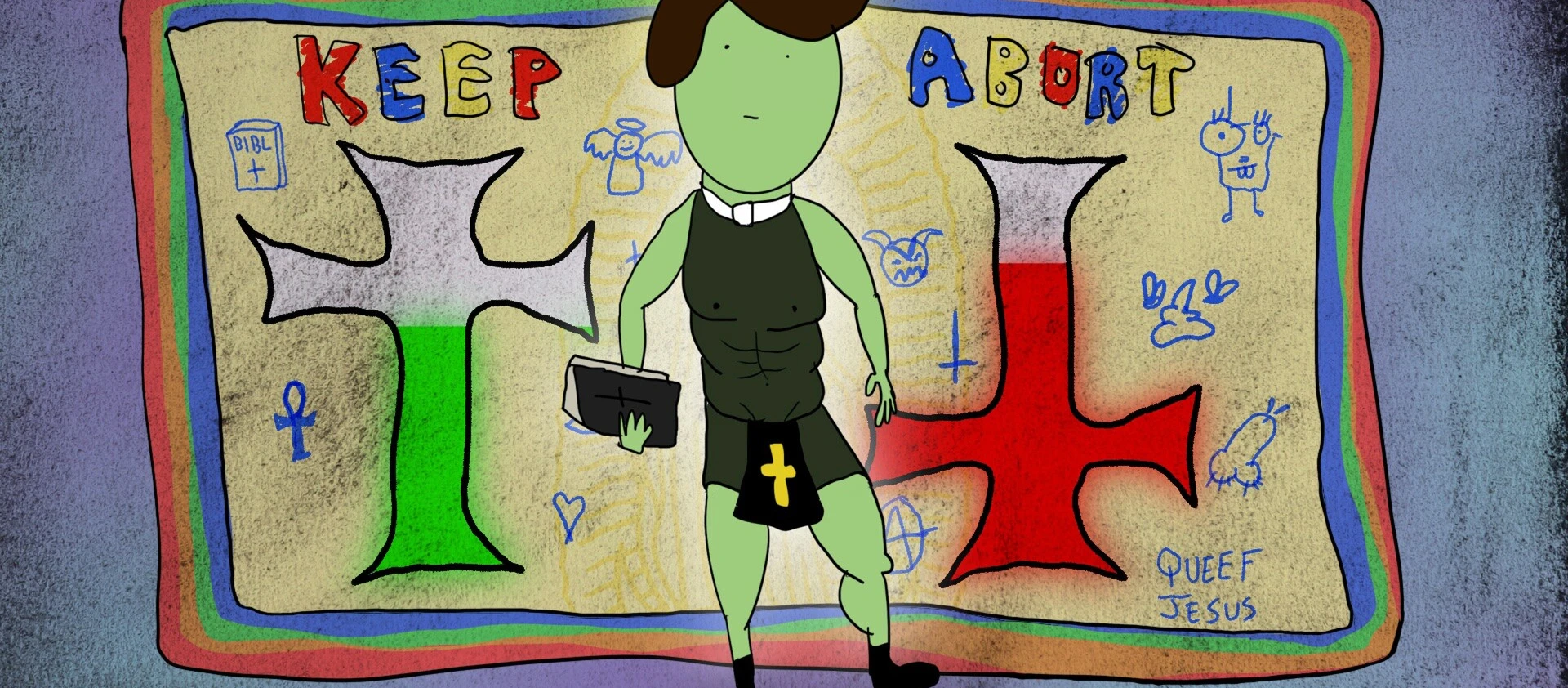
The film operates in two distinct visual registers: 2D digital animation and claymation. The hand-drawn segments are flat, graphic, and symbolic, like protest posters come to life, while the clay sequences are corporeal, textured, and confrontational. The shift to clay is reserved for moments of emotional gravity: a simulated birth, a literal facial assault, and other acts of bodily violation. These scenes are neither purely illustrative nor gratuitous – they are raw, elastic metaphors for the trauma of being objectified, controlled, and invisibly hurt. Clay, being malleable and messy, becomes a physical proxy for both vulnerability and resistance.
Throughout, Fraga-Abaza uses formal instability to reflect bodily and societal precarity. Images inflate, collapse, and morph, at times cartoonishly, at times grotesquely. The body is at once weaponized, sexualized, and commodified. As the title implies, Birth Controlled interrogates not just contraception but the broader structures that dictate reproductive rights and bodily autonomy. References to Trump-era politics, pop-religious iconography, reality television, and porn tropes swirl together in a visual montage that is equal parts satire and exorcism.
The film resists linearity in narrative. Instead, it builds in waves of escalation, using repetition and shock-value as rhetorical tools. Yet beneath the visual provocation lies careful calibration. Despite the film’s chaotic rhythm, Fraga-Abaza is attentive to how humor, discomfort, and anger can coexist. As she explains, the most difficult image to get right wasn’t a technical challenge, it was portraying that the protagonist had agency, however compromised. In one of the film’s more nuanced gestures, the character endures this trauma not passively but out of necessity, making money for her family, surviving in a system stacked against her. This complexity resists victimhood while not romanticizing endurance.
Produced in an academic environment marked by solidarity and shared exhaustion, the film bears the imprint of community. Fraga-Abaza acknowledges her peers’ emotional support during a time of personal medical crisis, which fed directly into the film’s charged tone. This blend of the personal and political is not accidental. Every frame, whether hand-drawn or sculpted, is steeped in lived experience.
Birth Controlled stands out among student animation not just for its bold aesthetics, but for its refusal to soften or compromise its voice. It’s unapologetically feminist, darkly comic, and definitely confrontational. Positioned at the intersection of body politics and experimental form, the film will resonate with audiences invested in reproductive justice, queer identity, and the ongoing battle against institutional violence. It is not always comfortable, but it is always deliberate.


